


Looking for a quote or to discuss your needs?
You can also review the documentation for technical details and purchasing information.
CH265 pH / Free Chlorine Analyser
- Product Details
- Specifications
- Installation
- Operation
Free Chlorine and pH, Measured and Controlled
The CHEMTROL® CH265 measures free chlorine directly, in ppm, together with the pH, and controls both automatically. Its 4–20 mA outputs send each reading to a dosing pump, a PID controller, a chart recorder or a building management system, so the water is both controlled and recorded.
It is built for municipal and bore water, wastewater and industrial process water, and for larger aquatic facilities that want a continuous signal. CHEMTROL® controllers have been proven in pools around the world for more than 30 years. Every setting is on the front panel, and the electronics carry a 5-year warranty.
Key Features
- Reads and controls true free chlorine in ppm, plus pH
- Programmable 4–20 mA outputs for control with an adjustable set-point, or for a chart recorder or PID controller
- Not affected by cyanuric acid stabiliser
- No reagents to buy and no pressure regulator
- Dry-contact remote alarm output
- Acid or base pH dosing, selectable
- Proportional feed and separate overfeed safety timers guard against overdosing
- Every setting clearly labelled on the front panel, and kept through power failures
- Rain- and splash-proof cabinet, with a 5-year electronics warranty
True Free Chlorine Readings
The free chlorine sensor reads free chlorine directly, in ppm (parts per million, the same as mg/L) — the same figure your DPD #1 test kit gives, not an estimate worked out from ORP.
Its big advantage is that cyanuric acid stabiliser does not throw it off, at any level. In outdoor pools, stabiliser makes ORP readings fall even when there is plenty of chlorine; the CH265 keeps reading, and holding, the true free chlorine level. The solid-state sensor needs no reagents and no pressurised cell, and it carries its own 2-year warranty.
CH265 Specifications
| Item | CH265 |
|---|---|
| Controls | Free chlorine (ppm) and pH |
| Sanitiser set-point | Free chlorine 0.1 to 10 ppm (factory setting 1.0 ppm) |
| pH set-point | 4.5 to 9.5 (factory setting 7.5) |
| Display range | Free chlorine 0 to 10 ppm; pH 0 to 14 |
| Accuracy | Free chlorine 0.1 ppm; pH ±0.1 |
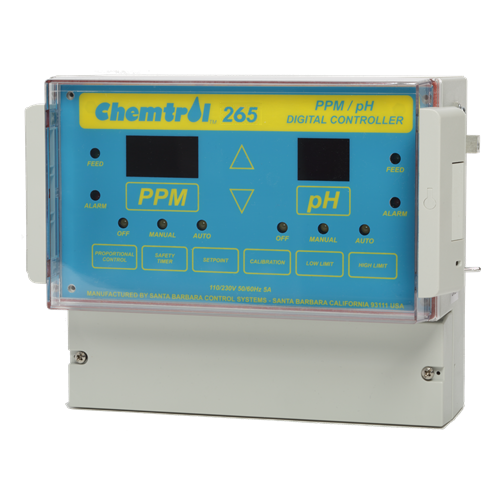
| Readouts | Digital LED readouts, ppm (3 digits) and pH (2 digits); indicator lights for feed mode, feed status and alarms |
| Free chlorine sensor | Solid-state, selective membrane, 0 to 10 ppm; not affected by cyanuric acid. Low-range (0 to 2 ppm) and high-range (0 to 200 ppm) sensors available |
| pH sensor | Glass electrode with 3 m cable |
| Feed modes | Off, manual or automatic; proportional feed |
| pH feed | Acid or base, selectable |
| Outputs | 4–20 mA outputs for chlorine and pH |
| 4–20 mA output | Standard; programmable for control with an adjustable set-point, or for a chart recorder or PID controller |
| Alarms | High and low out-of-range alarms and overfeed alarms; audible, visual and dry-contact remote alarm |
| Safety | Separate overfeed safety timers, sanitiser/pH interlock, diagnostic self-test, safety flow switch input; settings kept through power failures |
| Plumbing | Flow cell assembly with strainer, on a bypass line |
| Cabinet | Polystyrene, rain- and splash-proof, with clear window cover, 22 x 18 x 10 cm |
| Electrical | 230 VAC or 24 VAC (please specify when ordering); draws 0.25 A, excluding feeders |
| Warranty | 5 years on the electronic module; 2 years on the free chlorine sensor; 1 year on other parts |
Need a hand choosing sensors or connecting the 4–20 mA outputs? Call us on 1300 585 820.
CH265 Installation
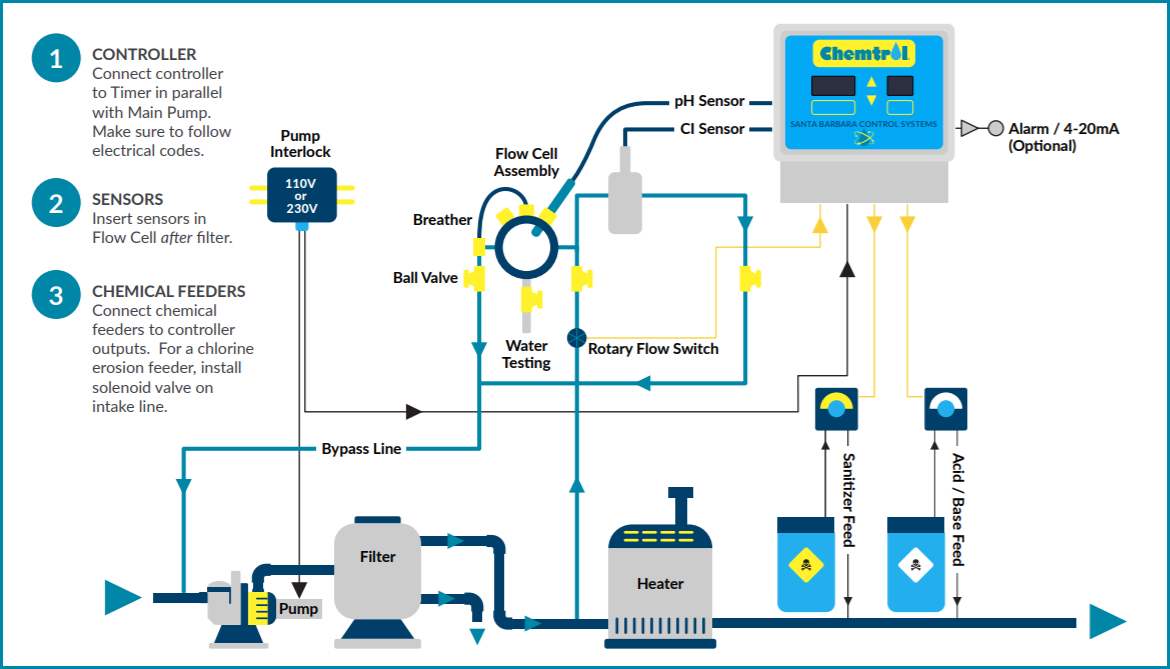
The CH265 is simple to install: there are no reagents to buy and no pressurised cell to fit. The free chlorine sensor and the pH sensor sit in flow cells on a small bypass line, as the diagram shows.
Controller
Mount the controller on a wall in a secure spot, out of direct sun and away from stored chemicals, at least 3 m from the water’s edge and close to the sensors. Wire it to the pump timer, in parallel with the circulation pump, so it can only dose while water is flowing. A qualified electrician should make the connection, following local wiring rules.
Sensors and Flow Cell
Take the bypass line from after the filter, through a strainer, to the Flow Cell Assembly. The clear cell lets you see the sensor tips, has a tap for taking water samples, and a bleed to stop air locks. Aim for a gentle, steady flow past the free chlorine sensor of 20 to 100 litres an hour, ideally about 30 litres an hour. Fit a safety flow switch on the bypass line, so no chemical is fed if the line is shut or blocked.
Before first use, soak the free chlorine sensor in lightly chlorinated water for 30 to 60 minutes, without connecting it to the controller. After start-up, check it against a DPD #1 test kit at 2 hours and again at 24 hours, and calibrate if needed.
Chemical Feeders
Connect the chlorine and the acid (or alkali) dosing pumps to the controller, and inject the chemicals downstream of the sensors and of the filter and heater. For a chlorine erosion feeder, fit a corrosion-resistant solenoid valve on the feeder’s intake line. For pools with a salt chlorinator, a membraneless free chlorine sensor is available.
CH265 Operation
Once set up, the CH265 runs itself. Every function is labelled on the front panel, the readouts show free chlorine and pH at a glance, and the 4–20 mA outputs carry both readings to your other equipment.
Factory Set-points
The free chlorine set-point comes set at 1.0 ppm and the pH set-point at 7.5, where chlorine works well and the water is neither corrosive nor scale-forming. These are factory defaults, not fixed values: the operator can change them at any time to suit the water and local health requirements. For drinking water, wastewater or process water, set them to your licence or process requirements.
Changing a Setting
Press SETPOINT, then PPM or pH — the display flashes. Use the up and down arrows to reach the value you want, then press SETPOINT again to save it. Alarm limits, safety timers and calibration are changed the same way, with their own buttons. Check the readings regularly against a DPD #1 test kit for free chlorine and a phenol red kit for pH, and calibrate if needed.
Alarms and the Safety Timers
Each reading has high and low alarm limits (from the factory, 0.3 to 6.0 ppm for free chlorine and 7.0 to 8.0 for pH), and a dry contact passes any alarm on to a remote alarm or your control system. The overfeed safety timers stop dosing and raise the alarm if a feeder runs too long — after an empty drum, a failed pump or a blocked line. Once the cause is fixed, switch the feed mode to Off and back to Auto to reset the timer.
Back to Factory Settings
Your settings are kept in memory, even through a power failure. To return a set-point and calibration to the factory values, hold the PPM or pH button for 5 seconds.