Chemical Feed Programs
Chemical Feed Programs - Overview and Operation
Overview
Effective chemical feed programs are essential for maintaining water quality in cooling towers. They play a critical role in eliminating microorganisms, including Legionella, and in minimising scale formation and corrosion.
Over the past 45+ years, we have continuously refined our chemical feed programs, working closely with customers to develop solutions tailored to a wide range of applications.
Operation
The ADDITIVES menu is designed to manage the feed of chemicals that are not directly controlled by sensor input, such as corrosion and scale inhibitors, non-oxidising biocides, flocculants, and dispersants.
Operators can customise the additives menu by selecting chemical names from a pre-defined list in the Configuration/Additives Sub-menu.
Each additive includes a sub-menu that allows you to:
- Set the control mode
- Configure alarms
- View individual feed events
- Monitor cumulative run-time
- Set up a Scheduled Booster
Control Mode Selection
The first screen of the Control Sub-menu allows the operator to select the desired control type:
- OFF (X)
- Manual (M)
- Automatic (A)
- Cycle Timer (T)
- Percent of Flow (F)
- Daily Schedule (S)
- 2-Week Schedule (B)
OFF Mode:
Selecting OFF immediately deactivates the feed control outlet and returns to the previous menu.
Manual Mode:
Selecting Manual immediately activates the feed control outlet and returns to the previous menu.
Caution: In Manual Mode, the outlet will remain activated until manually turned off. If the run time exceeds the operator-set Time Limit, the controller will automatically shut off the outlet to prevent overfeeding.
Click here for more information on Time Limit settings.
Automatic Control
In Automatic Control Mode, operators can choose between two chemical feed strategies:
- Bleed-and-Feed
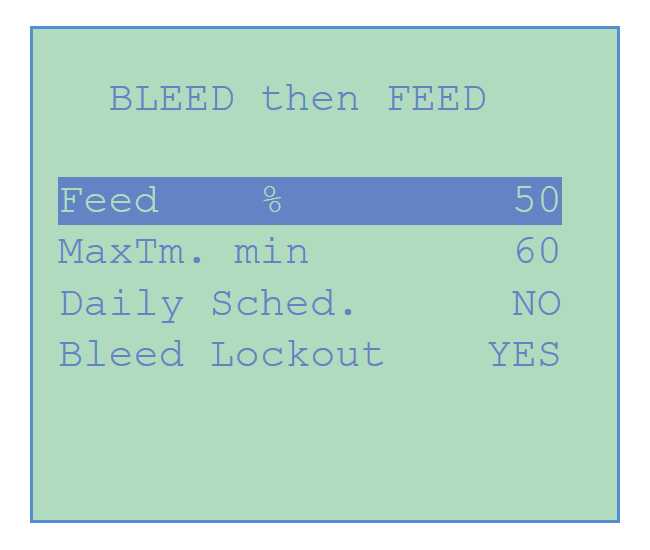
- Bleed-then-Feed (Post-Bleed as a Percentage of Bleed)
Bleed-and-Feed:
In this mode, the controller activates the feed outlet simultaneously with water bleed.
Within the Bleed-and-Feed Sub-menu, the operator can set:
- The percentage of bleed time dedicated to feeding.
- The maximum feeding duration in minutes.
If additional feeding is necessary, a supplementary daily schedule can also be programmed.
Bleed-then-Feed:
This mode helps prevent the loss of additives through the bleed water.
Here, the controller activates the chemical feed only after the bleed cycle is completed, based on a set percentage of the bleed time.
Bleed Lockout Function:
The Bleed Lockout feature prevents bleeding during and immediately after feeding.
It can also specify a pre-bleed and/or pre-pH adjustment sequence if required.
Cycle Timer Control
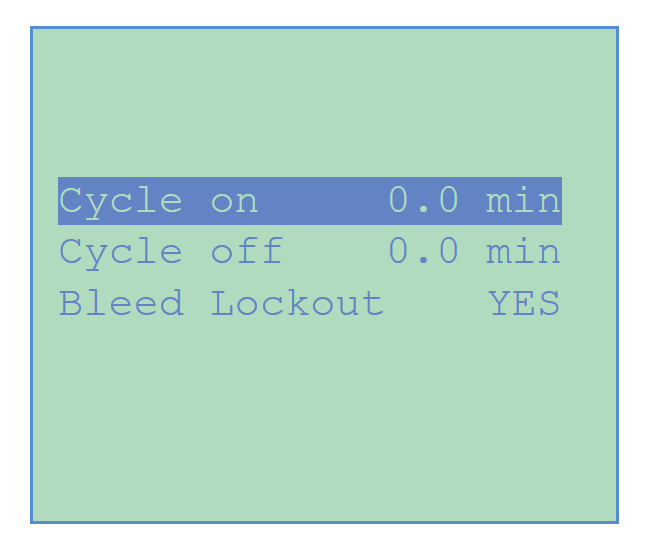
In Cycle Timer Mode, the controller activates the feed outlet based on fixed ON and OFF time cycles. Each cycle can be adjusted in 0.1-minute increments to fine-tune operation.
The Bleed Lockout function (displayed on line 3 of the menu) can be selected to:
- Prevent chemical feeding during bleed, and
- Prevent bleeding during and after chemical feed.
It can also specify pre-bleed and/or pre-pH adjustment if needed.
Percent of Flow Control
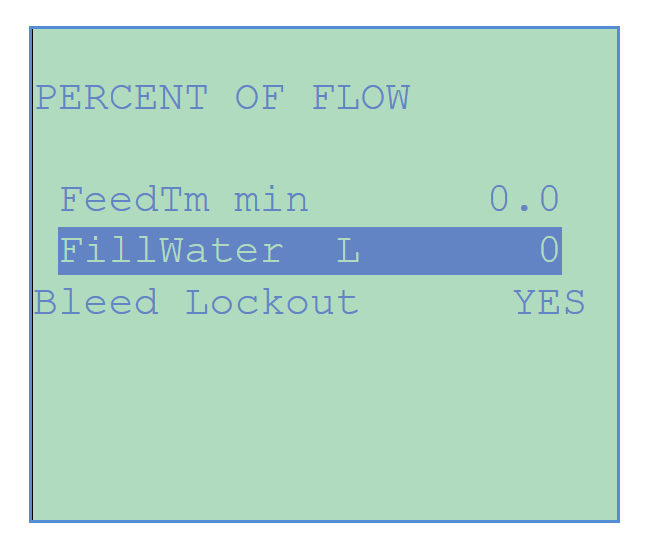
In Percent of Flow Mode, the controller activates the feed outlet for a time proportional to the volume of make-up (fill) water, as measured by the fill flowmeter (in gallons or litres).
The % Flow Sub-menu allows you to set the amount of feed time (in minutes) per selected volume of water.
The Bleed Lockout function can also be enabled to:
- Prevent bleeding during and after chemical feed, and
- Specify pre-bleed and/or pre-pH adjustment if required.
Daily Schedule Control
In Daily Schedule Mode, the controller activates the feed outlet at specific daily intervals — independent of sensor readings.
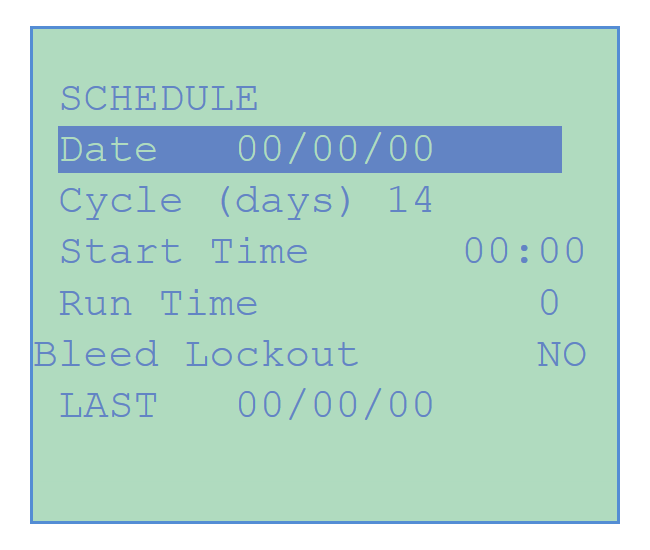
Selecting this mode opens the Daily Schedule Sub-menu, where the operator can:
- Set the Next Date for the first treatment,
- Define the cycle frequency (number of days between treatments),
- Specify the start time and treatment duration (in minutes).
The Last Date field shows the most recent treatment date.
The Bleed Lockout function is available to:
- Prevent bleed during and after chemical feed, and
- Configure pre-bleed and/or pre-pH adjustments if needed.
2-Week Schedule Control
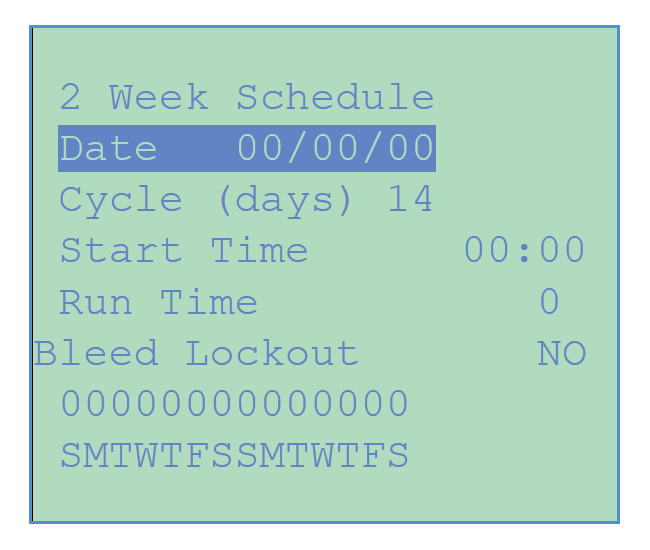
The 2-Week Schedule Mode works similarly to the Daily Schedule, but allows you to select specific days of the week for chemical feed.
Key programming points:
- The Date field must be set to the Sunday prior to the first feed date.
- In the Days Line, select feed days by changing a “0” to “1” for each desired day.
The Bleed Lockout function is available to:
- Prevent bleed during and after feed, and
- Set pre-bleed and/or pre-pH adjustments as needed.
Scheduled Booster / Single Shot
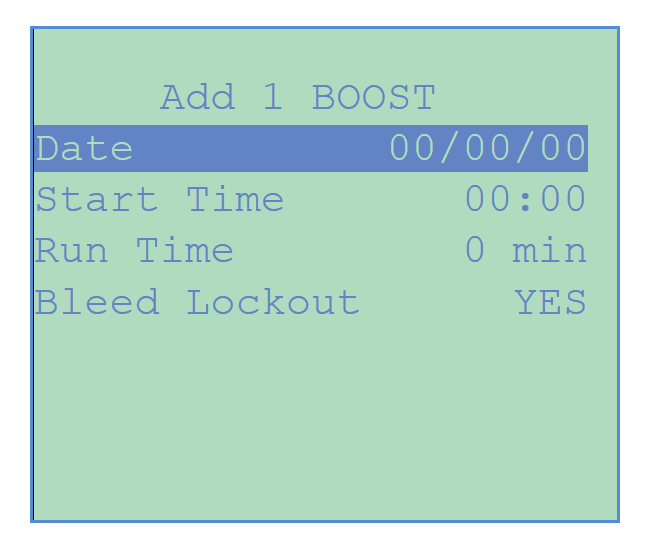
The Scheduled Booster (or Single Shot) function is used to program a one-time, delayed feed event — for example, feeding biocide at 1:00 AM for one hour.
This function operates independently of the main control modes.
In the Booster Sub-menu, you can set:
- Date of the event
- Start time
- Duration (in minutes)
The Bleed Lockout function is also available to:
- Prevent bleed during and after feed, and
- Set pre-bleed and/or pre-pH adjustments as required.
Bleed Lockout
The Bleed Lockout sub-menu is used to prevent bleed during or immediately after chemical feeding and to specify pre-bleed and/or pre-pH feed operations.
-
Line 1: Sets the Bleed Lockout time as a percentage of feed time.
A value greater than 100% prevents bleed during and after feed. -
Line 2: Enables Lock Memory, which accumulates feed lockout time until bleed is completed.
-
Lines 3 & 4: Configure the Pre-Bleed option to reduce the risk of deposits caused by rising conductivity or TDS levels during a lockout period.
Pre-bleed can be set for a specific time or until a target conductivity is reached. -
Lines 5 & 6: Set up the Pre-pH Feed option to adjust pH before chemical addition.
pH control can be based on time duration and/or reaching a target pH level.
The controller will maintain the pH target throughout the feed cycle.